



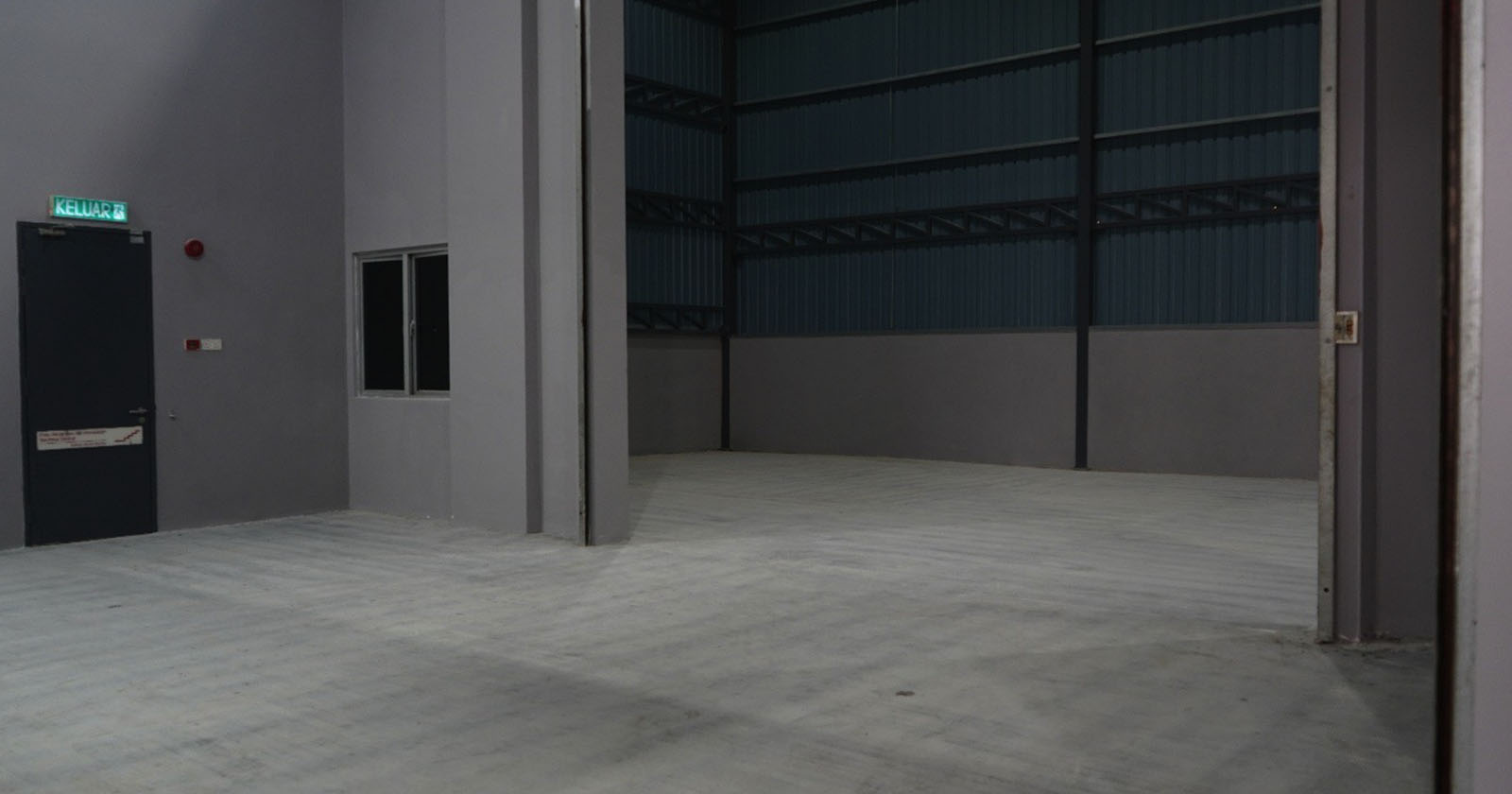
The warehouse floor before the system was applied, featuring a bare concrete slab
Why This Industrial Epoxy Flooring System Works For Warehouses
In industrial buildings, flooring is not just a finishing detail. It is part of the operational foundation. A warehouse floor must support heavy pallet loads, frequent forklift movement, abrasion, impact, and daily traffic without creating unnecessary dust, maintenance issues, or safety concerns.
In this project, a warehouse that had been left idle for years only had bare concrete flooring. While the structure itself was sound, bare concrete was not enough to support the real demands of industrial use.
As more warehouses and industrial spaces are repurposed for active operations, this challenge is becoming increasingly common. A concrete slab may appear acceptable at first glance, but once operations begin, its limitations quickly become visible.
Why bare concrete is not enough for warehouse operations
Bare concrete may appear strong, but it is rarely the best final surface for a working warehouse. Industrial performance requires more than compressive strength. The surface must resist abrasion, reduce dust, support movement, and remain easy to clean and maintain.
Over time, untreated concrete can generate dust, wear unevenly, and create a rough operating surface. This affects cleanliness, equipment movement, and maintenance cost.
The right approach: a complete industrial flooring system
For this warehouse, Nippon Paint implemented a complete multi-layer industrial epoxy flooring system engineered for operational use. Each layer serves a specific technical purpose, and the system works as a whole to deliver performance.
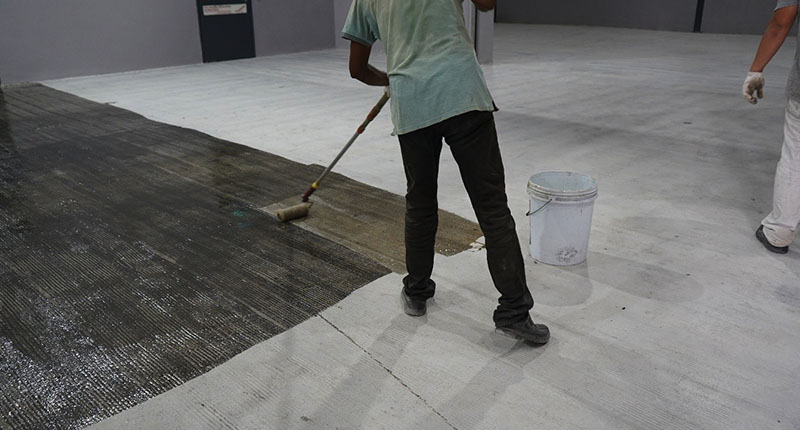
Applying NIPPON PAINT FLOORSHIELD SF Epoxy Primer as the first layer
Step 1: Epoxy primer for proper adhesion
The first layer was NIPPON PAINT FLOORSHIELD SF Epoxy Primer. This ensures strong bonding between the concrete substrate and the flooring system.
Proper adhesion is critical in industrial flooring. Without it, even a well-finished system can fail prematurely under heavy loads and traffic.
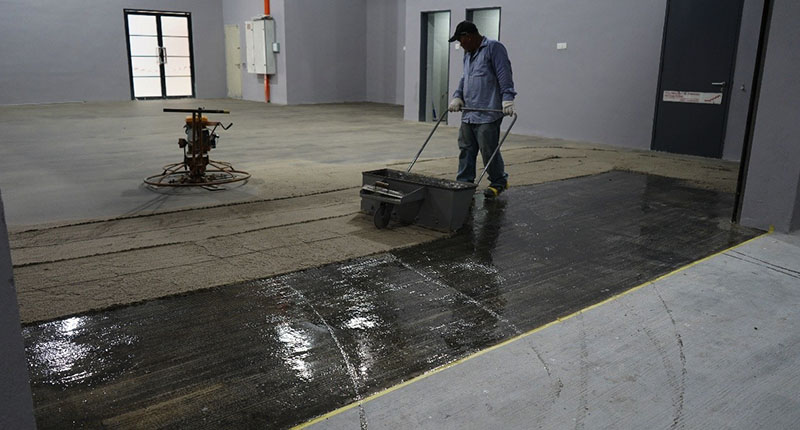
Applying NIPPON PAINT FLOORSHIELD SF Epoxy Mortar
Step 2: Epoxy mortar for strength and levelling
Next, NIPPON PAINT FLOORSHIELD SF Epoxy Mortar was applied. This acts as a high-strength, shrink-free underlayment that improves impact resistance and moisture protection.
It provides a stable and durable foundation for industrial operations.
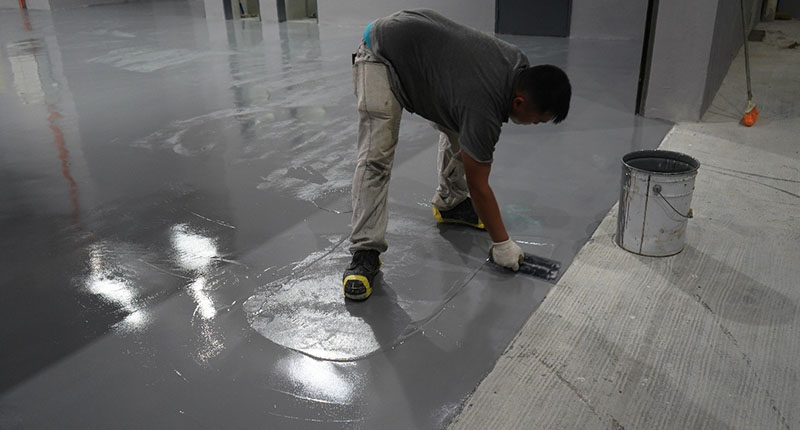
Applying the Nippon Paint SF Epoxy Op Texture Finish
Step 3: Texture finish to stabilise the surface
The epoxy texture finish was applied to seal the mortar layer and create a more uniform base for the final coating.
This improves consistency and strengthens the overall system.
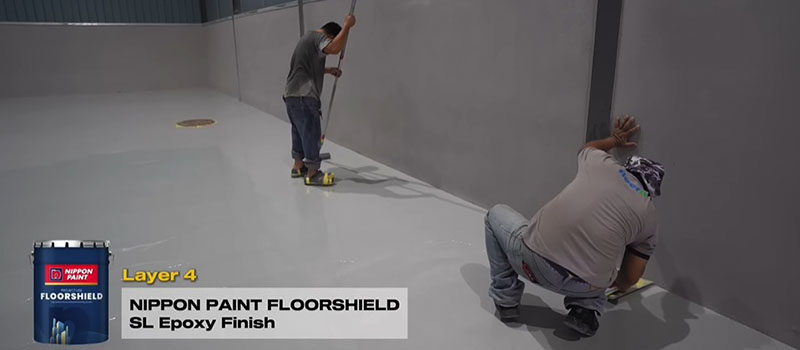
Applying the Nippon Paint Flooring SL Epoxy Finish
Step 4: Self-levelling epoxy finish for daily operation
The final layer was a self-levelling epoxy finish, creating a seamless, high-gloss, and easy-to-maintain surface suitable for industrial use.
Why this flooring system works for warehouses
The system delivers practical advantages:
A seamless surface
Reduces joints and unevenness.
A dust-free environment
Minimises dust compared to untreated concrete.
Abrasion resistance
Handles repeated industrial traffic.
Support for heavy loads
Suitable for forklifts and pallet movement.
Easier maintenance
Smooth surface simplifies cleaning.
Improved safety and efficiency
Supports smoother operations.
Why industrial flooring should be seen as a system investment
Industrial flooring affects efficiency, safety, maintenance, and lifecycle cost. It should be treated as a functional system, not just a decorative layer.
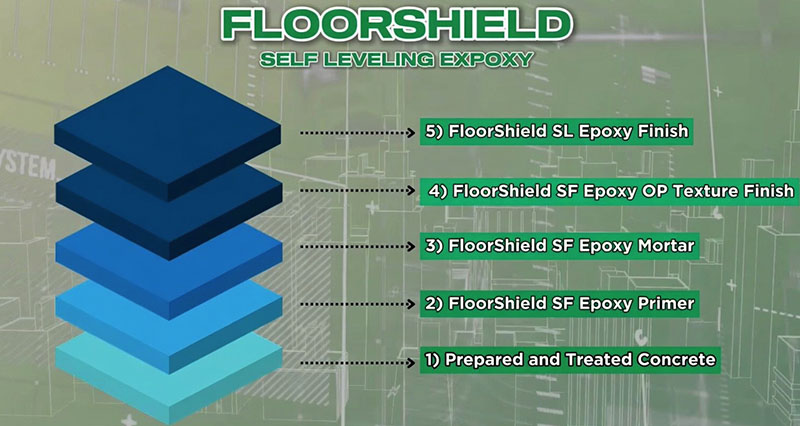
The full FloorShield system build-up
Why Nippon Paint’s approach matters
The value lies in designing a complete system from primer to topcoat. This ensures durability, cleaner operations, and long-term performance.
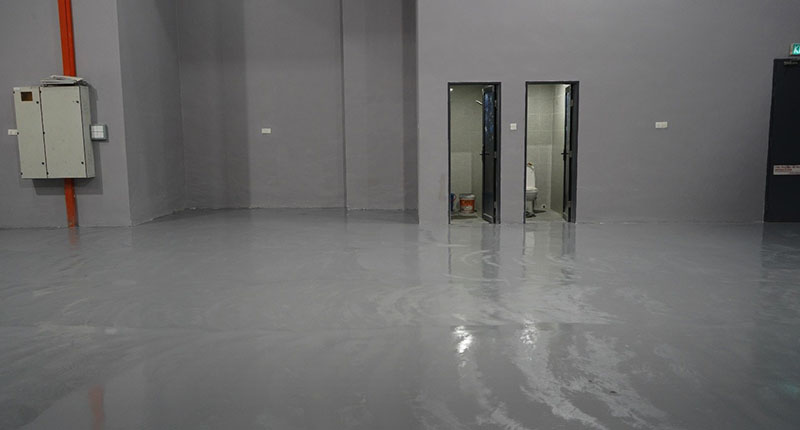
The completed warehouse flooring after the application of the Nippon Paint Flooring System
Conclusion
A warehouse floor must support traffic, loads, abrasion, and cleanliness. This project shows that a properly designed multi-layer epoxy system can transform bare concrete into a durable operational surface.
When flooring is planned correctly, it becomes part of the business infrastructure, not just a surface finish.
FAQ
Why is bare concrete not ideal for warehouses?
Because it can dust, wear under traffic, and be harder to maintain.
What is the benefit of epoxy flooring?
It provides a seamless, durable, dust-free, and easy-to-clean surface.
Can epoxy handle forklift traffic?
Yes, when properly specified as a multi-layer system.
Why is a multi-layer system better?
Each layer contributes to adhesion, strength, levelling, and protection.
What does self-levelling epoxy do?
It creates a smooth, seamless top surface.
Is industrial flooring just about appearance?
No. It affects safety, efficiency, maintenance, and long-term cost.
Contact Nippon Paint for your flooring solution needs.
To learn more, visit https://professional.nipponpaint.com.my/flooring-solutions/industrial-flooring or contact our Customer Careline at 1-800-88-2663 or email us at customercare@nipponpaint.com.my
FloorShield Solvent Free Epoxy Mortar is a 3-component shrinkage-free 100% solid underlayment that provides impact resistance in heavy-duty usages and permanent anti-osmosis system that outperforms all the temporary cementitious epoxy moisture barrier (TMB). It is an ideal system in heavy-duty high-impact production and warehouse floors especially in the lowest basement car parks such as Basement 6~7 where the hydrostatic pressure is greatest where conventional cementitious epoxy moisture barrier fails. Product Features: • Solvent-free thus no solvent smell • Impact resistance • 100% Solid thus zero shrinkage • Reduces moisture to < 2% wt /wt as early as 15 hours for over-coating • Excellent adhesion for overpayment • Independent of air-drift or environment moisture
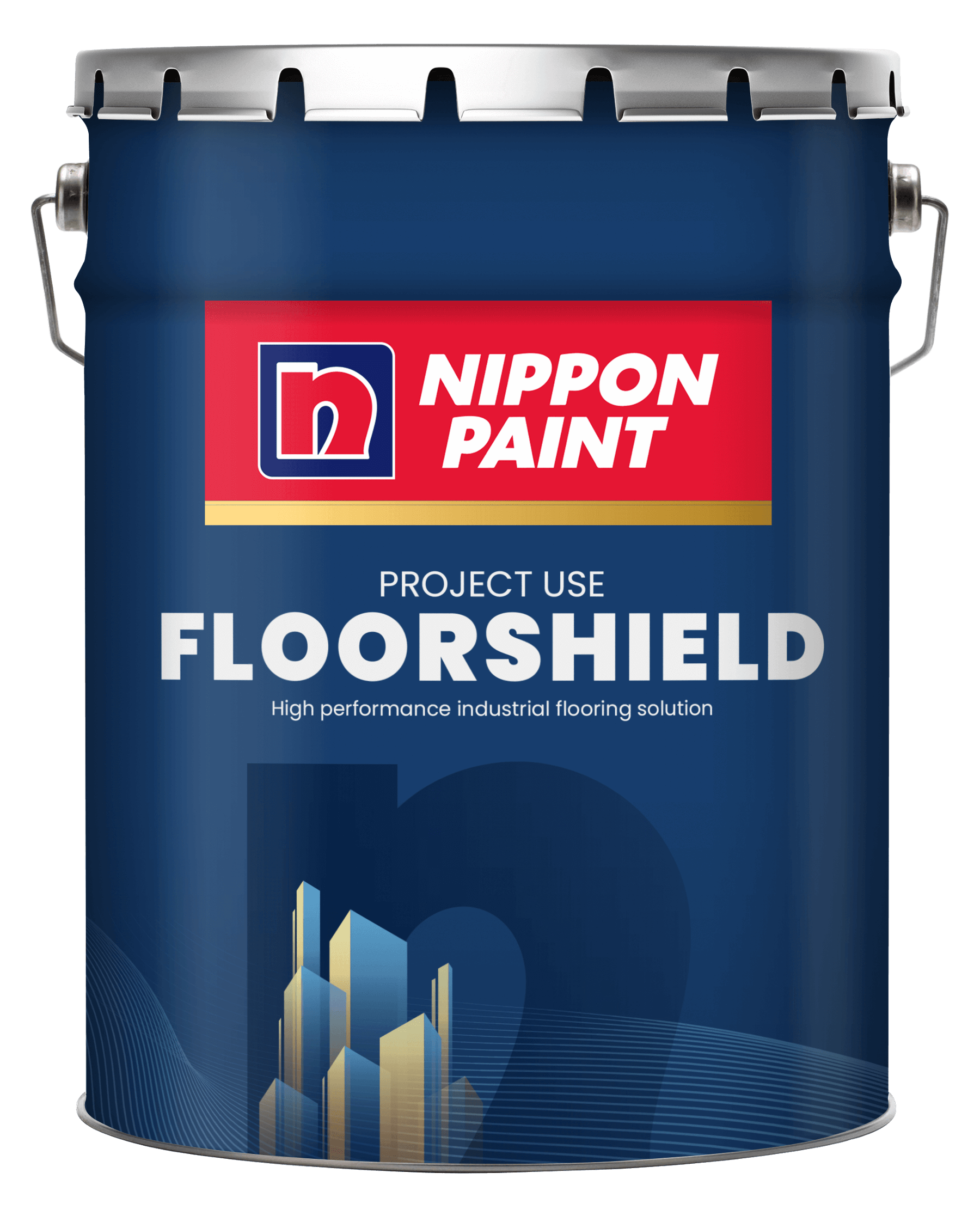
FloorShield Solvent Free Epoxy OP Texture Finish is a three-component thixotropic solvent-free epoxy coating is available in many colors. It is to be used on the primed floor as an economical abrasion and chemical resistance textured coating that gives an orange peel effect and also as a sealer coat for NIPPON FLOORSHIELD SF EPOXY MORTAR. Product Features: • Solvent-free thus no solvent smell • Abrasion resistant • Chemical resistant
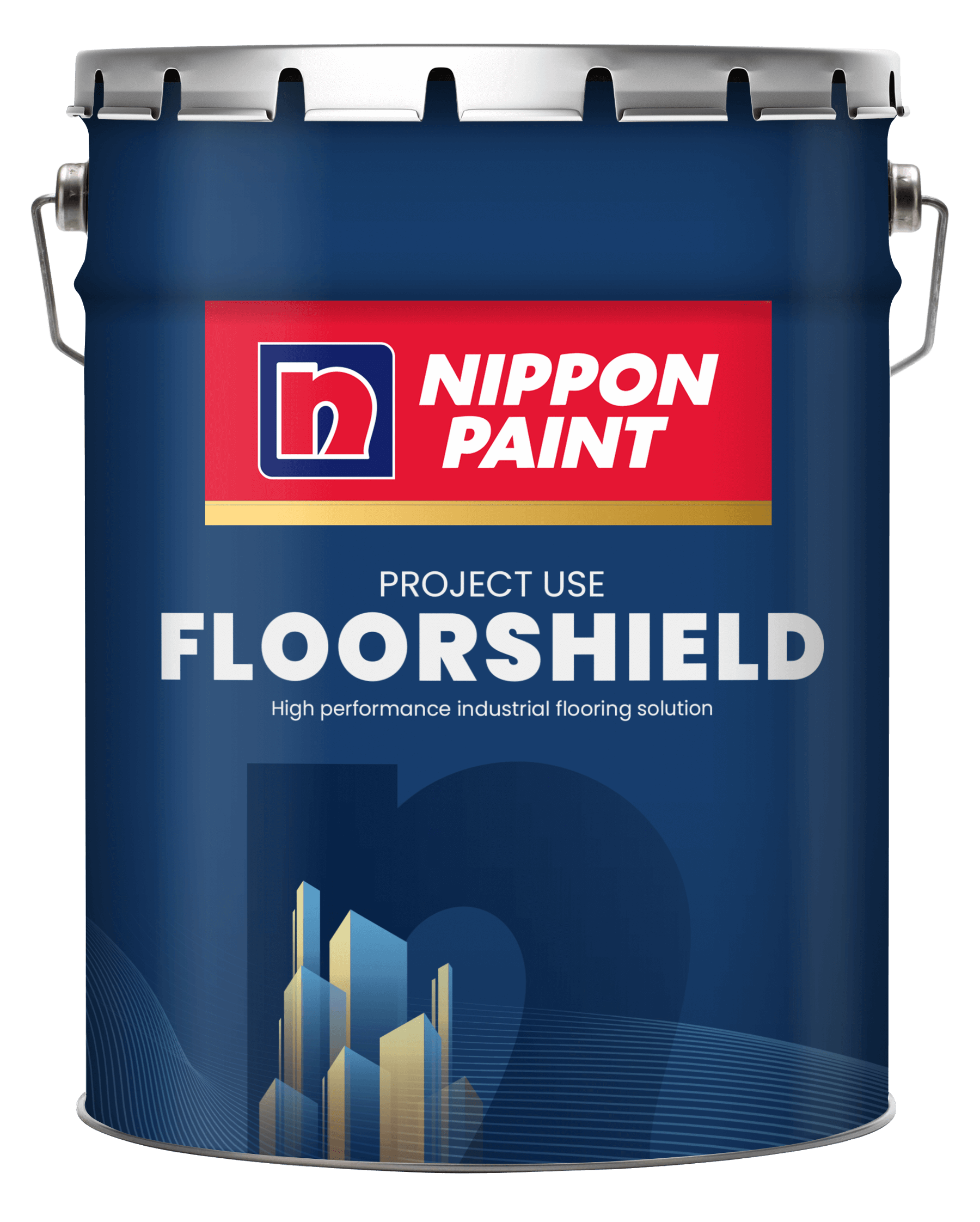
FLOORSHIELD SF EPOXY PRIMER is a two-component solvent free low viscosity 100% solid epoxy primer modified for excellent substrate wetting and penetration. It is to be used on prepared concrete to seal the porosity of concrete and provide penetration to enhance adhesion to prepare for polymer overlay Product Features: • Solvent-free thus no solvent smell • Low viscosity for penetration • Excellent wetting of substrate • Excellent adhesion for overlayment